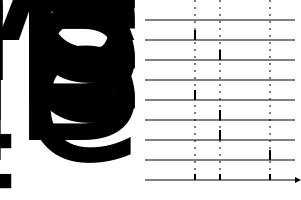
This example shows how causality relations can exist between unrelated time scales. Two CPUs with independent time scales (they is no tag relation between their clocks) compute a result A and a result B. When both results are available, the first CPU computes A+B:
As you can see on the result, without any information on the relative time scales on CPU 1 and CPU 2, TESL makes both tasks start at the same time, and makes time advance as fast as possible. Therefore A and B become available at the same time. Since there is not tag relation between the clocks on CPU 1 and CPU 2, they belong to different time islands, and the semantics of TESL makes time advance on each time island as fast as possible while obeying causality (the clock of CPU 1 is used as time reference in the following picture):